

The scary chart
You may have seen a chart doing the rounds called "Cyber risk goes parabolic". It's real.
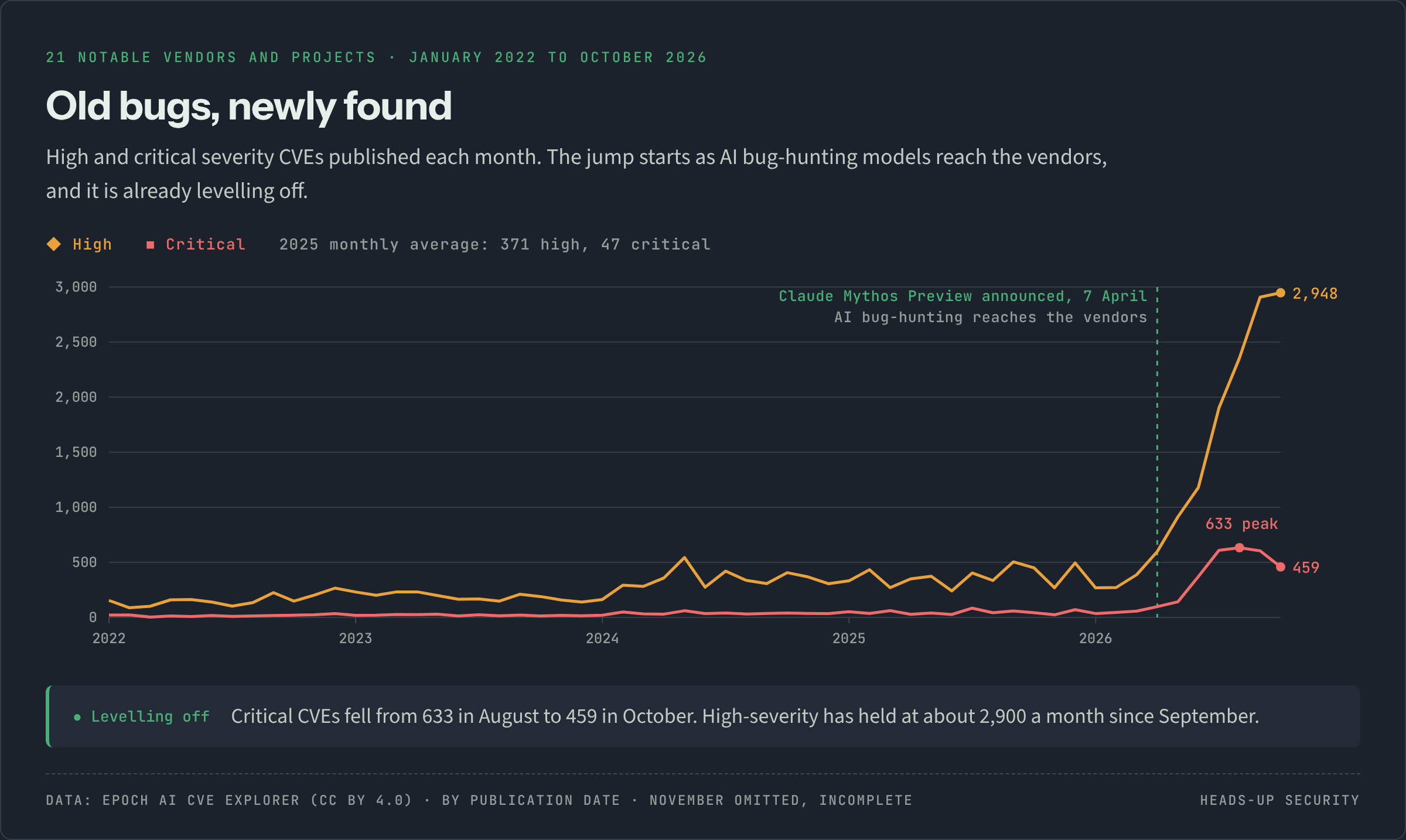
Epoch AI tracks the CVEs (published software vulnerabilities) from 21 of the biggest names in software, including Microsoft, Google, Apple, AWS, Cisco, Oracle and the Linux kernel. From 2022 until early this year, they published between about 90 and 550 high-severity flaws a month. Critical ones rarely went over 80.
Then it took off. In October they published 2,948 high-severity CVEs. Critical ones peaked at 633 in August. Last year's average was 371 high and 47 critical a month.
The easy conclusion is that AI-written code is making software worse. That's not what the data shows.
What's actually going on
In April, Anthropic announced Claude Mythos Preview, an AI model that is very good at finding security bugs, and started sharing it with software makers through Project Glasswing. OpenAI has similar cyber models. The vendors pointed them at their own code.
Mozilla is a good example. In April it fixed 423 security bugs in Firefox, and 271 of them were found with Mythos. One had been sitting in the code for 20 years.
So these aren't new holes. They're old holes, newly found. Some of the jump is also down to changes in how CVEs are reported and counted, and both Epoch and APNIC are careful to say so. But neither of them points to AI-written code as the cause.
It's temporary, at the source
Here's the good news. AI works through the backlog of old code, and the easy bugs come out first. Once vendors have been through their code, the flood slows down.
It's already happening. Critical CVEs fell from 633 in August to 459 in October, and high-severity has held at about 2,900 a month since September. It will probably settle higher than before, because AI bug-hunting is here to stay, but nowhere near this spike.
But not in your environment
A vendor fixing a bug is only half the job. The other half is you installing the fix, and every one of those fixes lands in someone's patch queue. Probably yours.
I've spent more than 25 years in IT, much of it on patching and security for large organisations, here and abroad. The hard part was never the vendor releasing a fix. It was getting that fix onto every system that needed it.
Every published fix also tells attackers exactly where to look, and they have the same AI tools we do. VulnCheck found that the median time from a CVE being published to confirmed exploitation fell from 120 days in 2025 to 80 days in the first half of 2026 (CSO Online).
The wave passes through the vendors in months. It can sit in your environment for years, especially on things that never get patched: end-of-life servers, network kit, firmware and OT.
The bugs that don't make the chart
There's another kind of AI risk that doesn't show up on that chart at all: apps built quickly with AI, often called vibe coding. In February I wrote that vibe coding is real, and it is frightening. It still is.
They have plenty of holes. When Escape.tech scanned about 5,600 vibe-coded apps last year, it found more than 2,000 vulnerabilities, more than 400 exposed secrets and 175 cases of exposed personal data. But a startup's app or an internal tool almost never gets a CVE, even when someone finds and fixes the flaw. Those bugs are invisible to the statistics. That makes them a blind spot.
The models are getting better. Veracode's latest tests show the share of AI-written code that passes its security checks rose from 56% to 62%, and the best models now reach 73%. As the tools mature, vibe-coded apps will get safer. But for now more than a third of AI coding tasks still produce vulnerable code, and the models still get common flaws like cross-site scripting and log injection right less than one time in five. Safe AI-built software still comes from the process around it: a clear spec, a security review, scanning, and someone who understands what's shipping to production.
Patch the right things, not everything
Only a small fraction of CVEs is ever exploited in the wild. VulnCheck puts it at 1.4%, and other counts put it lower still. If you try to patch everything at once, you'll drown. If you patch the ones that are actually being exploited first, you'll stay ahead.
And remember that more patching means more change. As the Microsoft 365 and FAA outages showed earlier this month, change is a risk of its own. Patch faster, but don't skip testing and rollback.
For leadership: five questions for your team
- Do we know everything we run, including network devices, firmware and systems nobody owns?
- How long does it take us to apply a critical patch, and is that number going up?
- How do we decide what to patch first?
- Which systems can't be patched any more, and what's protecting them?
- If a vendor ships an emergency fix on a Friday, who's on it by Monday?
For technical teams: what to do
- Know what you run. Keep an asset inventory with versions, so you can answer "do we run this?" in minutes, not days.
- Prioritise on real-world risk. Use CISA's Known Exploited Vulnerabilities list and EPSS, not the CVSS score alone.
- Measure patch lag. Track how long fixes take to reach production, not just how many patches you applied.
- Automate the routine. Let tooling handle the everyday patches so people can spend their time on the hard ones.
- Fence off what you can't fix. Isolate or retire systems that no longer get updates.
- Plan for bigger patch days. Make room for more testing, keep rollback tested, and agree maintenance windows in advance.
- Hold AI-built apps to the same standard. Scan them, review them and put them on the asset list, even if they started as a weekend project.
What actually matters
The bugs were always there, and now we can see them. That's good news, as long as we act on it.
The question isn't how many CVEs were published this month. It's how many of them are sitting in your environment, and whether you know which ones matter.