

Everyone assumed the worst
The past week brought an avalanche of outages and cyber headlines. With it came the usual panic, as organisations big and small wondered whether they're next.
It's natural to assume there's an attacker behind every outage, or these days, AI gone rogue. But the two biggest outages of the week had nothing to do with hackers or AI.
What actually happened
Microsoft 365
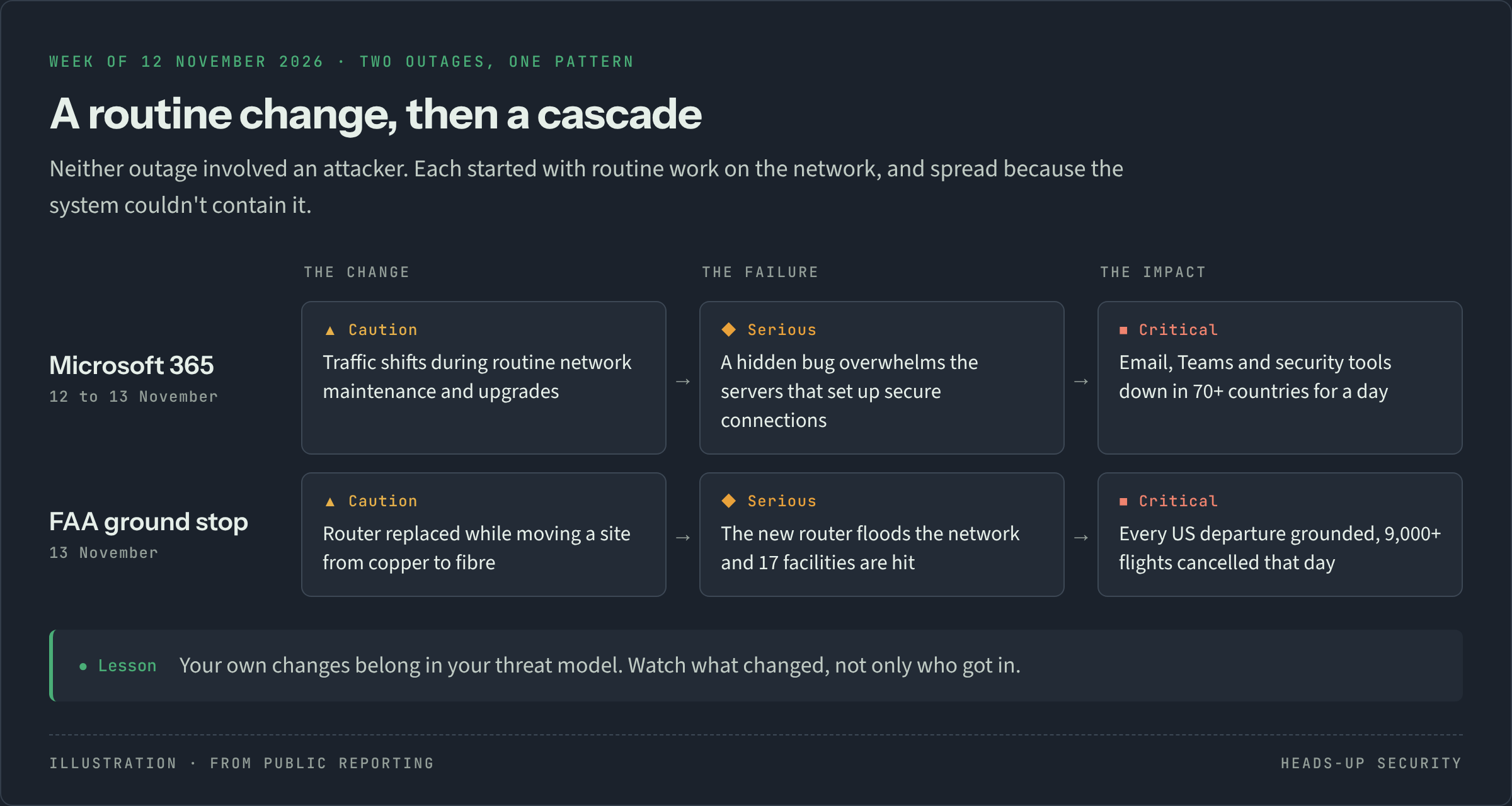
On 12 November, Outlook, Teams and the rest of Microsoft 365 went down for users in more than 70 countries. It took about a day to get back to normal.
Microsoft ruled out a cyber attack and AI early on. Its preliminary report says traffic shifts during routine network maintenance and upgrades exposed a hidden bug in the systems that set up secure connections.
Microsoft's own security tools went down with it. Defender and Intune were both affected. So a lot of security teams lost sight of their own environment at exactly the moment everyone was asking whether they'd been breached.
The FAA ground stop
A day later, on 13 November, the US Federal Aviation Administration stopped every departing flight in the country for almost five hours. More than 9,000 flights were cancelled that day alone, and the knock-on effects ran into Sunday.
Again, not a cyber attack, and officials found no sign that AI played a part. A contractor was replacing a router while moving a remote FAA site from copper to fibre. The new router flooded the network with login attempts, and the problem spread to 17 facilities (CBS News). The FAA is still working out whether it was a faulty router or human error. Either way, it started with planned work.
Change is a vulnerability too
In both cases, nobody broke in. People doing routine work to keep the systems running caused the damage.
We put a lot of effort into keeping attackers out. We put far less into the updates, configuration changes and hardware swaps we make ourselves every week. Each one is a chance to take ourselves offline.
Cyber resilience is about staying up when something goes wrong, whatever the cause. If you can't see the effect of your own changes, that's a blind spot, and it's as serious as an unpatched server.
Questions worth asking this week
Before you ask whether you're next, ask whether you'd even know. A few questions to start with:
- Do you know every change made to your critical systems last week, and who approved it?
- Can you roll back a failed update quickly, and have you actually tested that?
- If your security tools go down with your cloud provider, what can you still see?
- Which single supplier or system could stop your business for a day?
- Do your people know how to keep working when email and Teams are down?
If the honest answer to any of these is "not sure", you've found a blind spot.